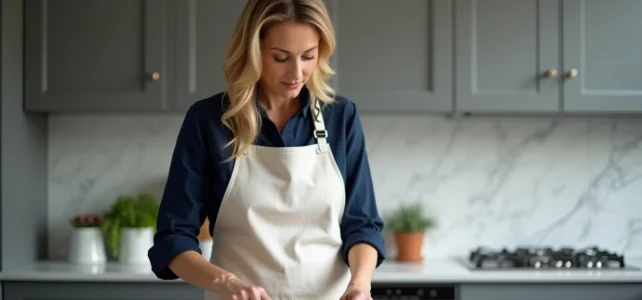
We’ve all experienced that moment when a recipe calls for chopping vegetables into brunoise and the knife slips because the blade is no longer sharp. Being well-equipped in the kitchen isn’t about filling drawers: it’s about choosing a few utensils, but the right ones, those that last over time and cover the majority of everyday tasks.
Cooking Utensil Materials: Stainless Steel, Cast Iron, or Non-Stick
Before making a list of equipment, we need to address the material question. It determines the lifespan, heat behavior, and maintenance. Too many amateur cooks buy a low-cost non-stick pan every year, while a single well-chosen stainless steel piece lasts a decade.
18/10 stainless steel remains the most versatile choice for pots and sauté pans. It does not react to acids (tomatoes, white wine), can go in the oven without restrictions, and cleans easily without special precautions. Its downside: it conducts heat poorly on its own. Therefore, we prefer models with a encapsulated base (a layer of aluminum or copper sandwiched) to distribute temperature evenly.
Enameled cast iron excels for long cooking (braises, stews) due to its thermal inertia. On the downside, it is quite heavy, and preheating must be gradual to avoid cracking the enamel.
For frying pans, non-stick remains genuinely useful for two specific tasks: eggs and pancakes. Outside of these uses, a stainless steel or cast iron pan does the job without needing to replace the coating.
As of January 1, 2025, plastic containers for cooking and reheating are banned in collective catering in France, accelerating the shift towards stainless steel, glass, and ceramic. Detailed selections of this type of equipment can be found on the equipment on Les Coudes sur la Table, categorized by practical use.
Kitchen Knife: Three Blades Are Enough for Everything
We often come across blocks of six, eight, or ten knives. The reality is that three well-sharpened knives cover almost all cutting tasks. It’s better to invest in the quality of these three blades than to spread the budget over a complete set.
- A paring knife (blade 8 to 10 cm) for peeling, turning vegetables, and peeling fruits. It’s the precision knife, the one you always keep within reach.
- A chef’s knife (or slicing knife, blade about 20 cm) for chopping, slicing, and mincing. It’s the centerpiece: it does the bulk of the work on the cutting board.
- A serrated bread knife, which is also used to slice tomatoes without crushing them.
A common mistake: storing knives in a drawer haphazardly. The blades clash and dull within weeks. A wall-mounted magnetic strip or an individual blade guard solves the problem. And a honing steel used before each cutting session keeps the edge sharp much longer than an annual trip to the sharpener.
The Mandoline, an Underestimated Complement
For vegetable juliennes, homemade chips, or uniform slices of cucumber, the mandoline saves considerable time. Choose one made of stainless steel with an integrated safety pusher. Feedback varies on V-blade models compared to straight blades, but both work well as long as the finger guard is used consistently.
Frying Pan, Saucepan, and Baking Dish: The Cooking Trio to Prioritize
A cupboard overflowing with mismatched dishes doesn’t make one a better cook. Efficiency is gained with a small trio, chosen to cover everyday cooking methods.
A 28 cm frying pan is the standard size for searing a piece of meat, sautéing vegetables, or cooking an egg. Made of thick stainless steel or cast iron, it can go from the stovetop to the oven without restrictions. For delicate cooking (omelets, fragile fish), we add a small 24 cm non-stick frying pan.
For saucepans, two sizes meet almost all needs: a medium saucepan for sauces, hard-boiled eggs, and rice, and a larger stockpot for soups, pasta, and broths. The stockpot is a great replacement for the large pot for a household of two to four people.
For the oven, a single rectangular dish in ceramic or glass covers gratins, roasts, and roasted vegetables. We avoid too-small dishes that require multiple batches.
Storage and Work Surface: Organizing for Quick Cooking
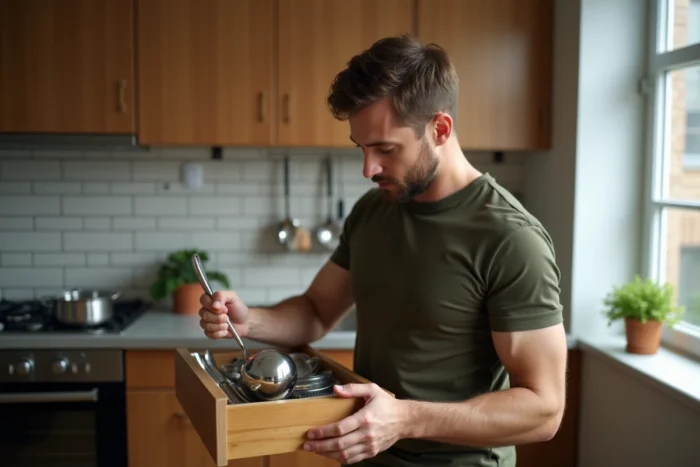
A clear work surface radically changes comfort in the kitchen. The current trend encourages abandoning high cabinets in favor of open shelves and hanging bars, making every utensil accessible without opening a door.
A few simple rules work well in daily life. The utensils used at every meal (slicing knife, spatula, cutting board) stay within reach, on the work surface or on a wall bar. Appliances that are used less often (food processor, immersion blender) go in a lower cupboard.
For food storage, we prefer glass containers with airtight lids. They can go from the refrigerator to the oven, clean easily, and do not retain odors, unlike plastic containers that often end up warped after a few trips in the microwave.
Small Equipment That Makes a Difference Daily
Beyond the main pieces, a few inexpensive accessories significantly enhance the cooking experience.
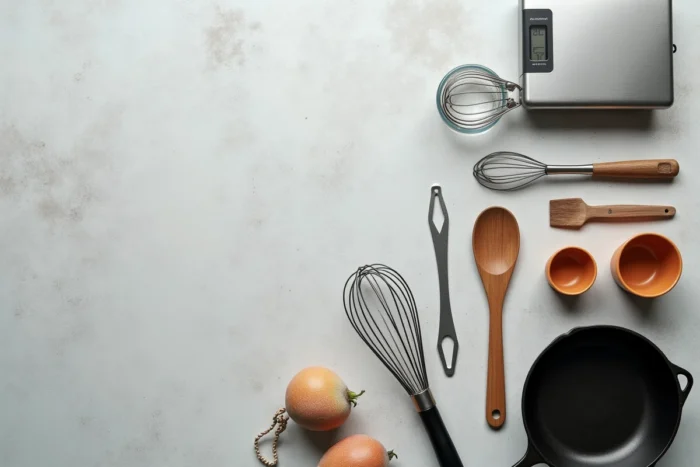
- A digital kitchen scale to follow recipe proportions without approximation.
- A probe cooking thermometer, useful for roasted meats and confections (caramel, jams).
- A stainless steel colander with feet, which sits in the sink and frees up both hands.
- A stainless steel mixing bowl (large bowl with a rounded bottom), essential for whipping egg whites, mixing dough, or preparing a marinade.
Buying less but better remains the most cost-effective principle in the long run. A good slicing knife and a decent stainless steel saucepan represent a modest investment that pays off over years of daily cooking. The rest can be gradually completed, based on the dishes you actually prepare, not those you imagine making one day.