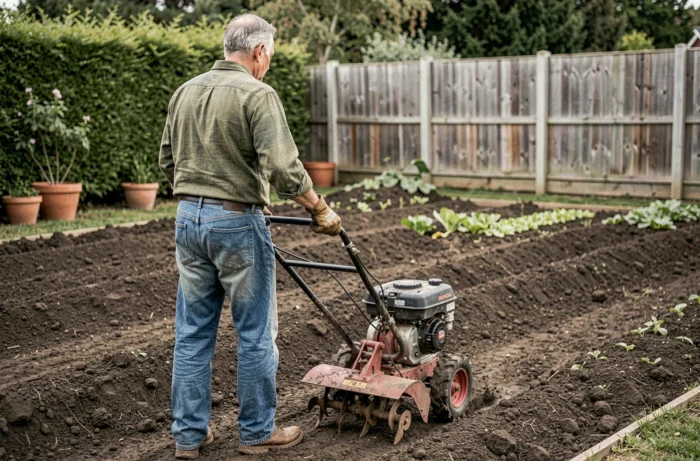
The Honda FG320 occupies a special place in the Honda gardening catalog. Positioned between small auxiliary tillers and heavy tillers, this thermal tiller equipped with the GP160 engine targets gardeners working on medium to large areas. The technical sheets available online provide sometimes conflicting data, particularly regarding the actual working width. A careful examination of what the sources allow – and do not allow – to assert is essential before making a purchase.
Honda GP160 Engine: What the Displacement Doesn’t Reveal in the Field
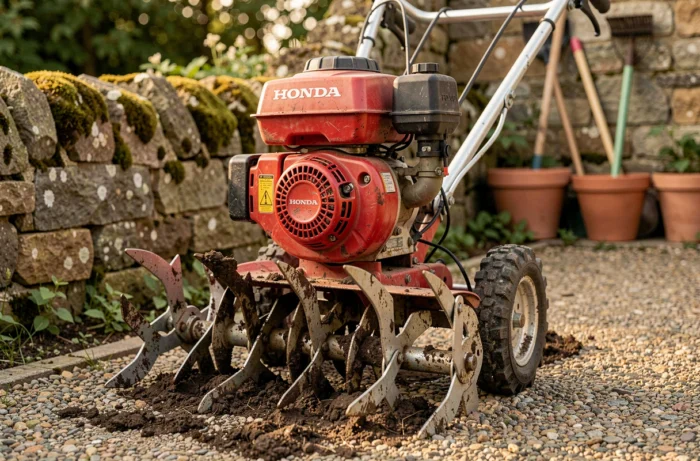
The four-stroke Honda GP160 engine is the mechanical heart of the FG320. Its displacement of 163 cm³ places it in the category of medium power engines for gardening equipment. Honda uses this engine block on several machines in its range, which facilitates the availability of parts and access to routine maintenance (oil change, air filter, spark plug).
The reliability of the GP160 is rarely criticized in user feedback published on specialized forums. Discussions in gardening mechanics groups mention this engine as a durable block, provided that the oil change intervals are respected and an oil suitable for four-stroke engines is used.
As you can read on Agriculture Et Paysage, the FG320 has a solid reputation for the durability of its engine block. But the engine alone does not predict the machine’s performance in the field. The stability in compact soil, the ease of maneuvering at the end of rows, or the effort required to free the tiller from clay soil depends as much on the transmission and weight as on the engine’s raw power.
Working Width of the FG320: A Data Point to Verify Before Purchase
The commercial sheets display varying working widths for the Honda FG320. This discrepancy is not trivial for a buyer who sizes their equipment based on the size of their vegetable garden or plots.
The effective width depends on the configuration of the tines mounted on the machine. Depending on the number of tines installed and the accessories used, the actual coverage may differ from the value stated in the generic specifications. A real-world test remains the only reliable way to confirm the working width suitable for your land.
This issue is not anecdotal: an overestimated width leads to disappointed expectations regarding hourly yield, while an underestimated width could steer a buyer towards a model oversized for their use. Therefore, before comparing the FG320 to a heavier tiller, it is essential to clarify this data with the dealer or during a demonstration.
Transmission and Reverse: An Asset for Large Vegetable Gardens
The FG320 features a transmission that includes a reverse gear. This characteristic distinguishes it from many thermal tillers in its price range, where reverse is often absent or offered as an option.
In practice, the reverse gear changes the way of working on cluttered plots or at the end of rows. Without it, the gardener must manually lift and reposition the machine, which quickly generates fatigue during sessions lasting several hours.
- The reverse gear facilitates clearing in heavy soils where the tines tend to sink and block progress
- It allows for correcting the trajectory without disproportionate physical effort, a clear advantage on slightly sloped terrains
- In large vegetable gardens, it reduces maneuvering time between rows and improves the efficiency of each pass
The presence of a reverse gear transforms the tiller into a continuous working tool, whereas a model without this function requires frequent pauses to reposition the machine.
Ergonomics and Known Limitations of the Honda FG320
The handlebar of the FG320 is adjustable in height, allowing the working position to be adapted to different body types. The controls are grouped at the handles, a classic design from Honda that avoids complex manipulations during soil work.
Some limitations deserve to be noted. No documented comparative tests in the available sources allow for a precise quantification of the effective working depth in different types of soils. The data published on the technical sheets indicate a capacity for working depth, but actual performance varies greatly depending on the nature of the terrain: sandy soil does not hold up like compacted clay after a rainy winter.
The question of compliance with Stage V regulations, which concerns non-road machinery engines in Europe, also remains open. European regulation 2016/1628 is gradually applied to different categories of engines, but the exact category of the GP160 in this context is not specified in the accessible sources. A buyer concerned about long-term compliance should verify this point directly with Honda or an authorized dealer.
Routine Maintenance: What to Expect
The maintenance of the FG320 follows the standard protocol for Honda four-stroke engines. Engine oil changes, air filter replacements, and spark plug checks are recurring operations. Honda recommends a four-stroke oil suitable for the conditions of use.
The availability of spare parts and consumables (engine oil, filters) at specialized gardening equipment dealers is a concrete advantage compared to less widely distributed brands. This parameter impacts the total cost of ownership in the medium term.
Honda FG320 Tiller: For Which Gardener and Which Terrain
The FG320 is aimed at gardeners who manage areas larger than just a simple vegetable patch. Its engine, transmission with reverse, and working width position it in the segment of tillers capable of handling significant plots without crossing into the category of agricultural tillers.
For a small urban garden, this machine is likely oversized. An electric tiller or a more compact thermal model would suffice. However, for an extended family vegetable garden or a semi-rural plot worked several times a season, the FG320 offers a coherent power-handling ratio.
The lack of independent comparative data limits the ability to position it against its direct competitors based on measured criteria. The final choice benefits from being based on a trial at the dealership rather than solely on technical sheets, whose observed discrepancies remind us that a field verification remains the best guarantee.