The durability of ink on fabric after washing depends less on the type of ink chosen than on the rigor applied at each stage of the fixation process. Incomplete polymerization, poorly calibrated press, unprepared substrate: each weak link degrades the strength of the final result. Here, we detail the technical parameters that truly condition the long-term fixation of ink on fabric.
Polymerization and drying tunnel: the parameters that change everything
An ink that feels dry to the touch is not necessarily polymerized. Polymerization refers to the chemical cross-linking of the binder contained in the ink, which makes the film resistant to rubbing and washing. Without this complete step, colors migrate from the first wash cycle.
Two main methods allow for achieving this result: the heat press and the infrared drying tunnel. In textile screen printing, the tunnel remains the reference for production volumes. The heat press is more suitable for small runs and direct-to-garment (DTG) printing. Several complementary techniques contribute to a durable ink fixation on fabric, depending on the process used.
The temperature and exposure time must be adjusted according to the ink manufacturer’s technical data sheet. Epson, for example, specifies that insufficient fixation leads to bleeding during washing or contact. Applying a generic setting without checking compatibility with the ink system used is the primary cause of poor adhesion.
Check rather than guess
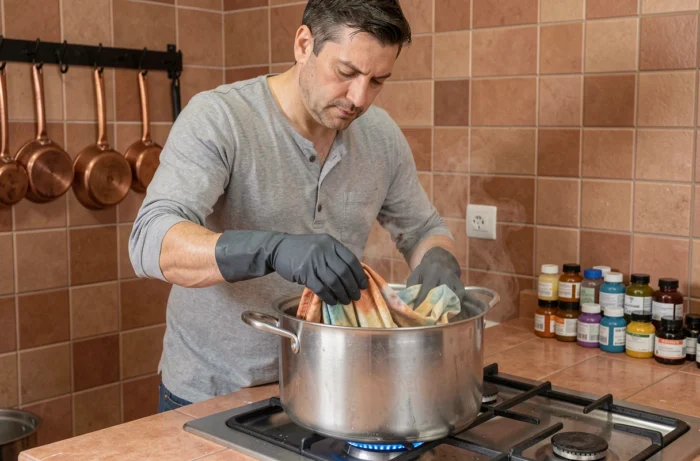
A wash fastness test according to the ISO 105-C06 standard evaluates color change and color transfer on adjacent fabrics after washing under defined conditions. This standardized protocol allows for objective comparison of two settings or two inks, instead of relying on visual inspection after drying.
In practice, conducting a test on the actual fabric-ink-fixation combination before starting production avoids unpleasant surprises. A sample washed three times under the customer’s actual usage conditions is worth more than any supplier’s promise.
Screen printing inks versus DTF inks: adapting the method to the process
The plastisol inks used in screen printing form an opaque film on the surface of the fabric. Their fixation relies on precise thermal flashing: too short, the plastisol remains sticky and fragile; too long, it can yellow or stiffen the textile.
Water-based inks, increasingly common for their softer feel, penetrate the fiber. Their drying requires complete evaporation of the water before polymerization of the binder. A too-quick passage through the tunnel leaves residual moisture that compromises adhesion.
Particular case of DTF
In DTF (Direct to Film) printing, durability does not depend solely on the ink. The complete chain includes:
- The application of a hot melt powder on the printed film, which serves as an adhesive between the ink and the textile
- The polymerization of the film in an oven or tunnel before transfer, a step that conditions the cohesion of the entire ink-adhesive assembly
- The final pressing on the garment, where the temperature, pressure, and time must match the specifications of the powder and film supplier
A deviation in any of these parameters, even slight, can cause premature cracking or partial detachment after a few washes. Compatibility between the type of powder and the nature of the textile substrate is as important as the quality of the print itself.
Cotton fabric preparation: the overlooked step that ruins fixation
Cotton absorbs ink well, making it the most common substrate in textile printing. However, poorly prepared cotton may contain residues of industrial sizing (softeners, anti-wrinkle agents) that create an invisible barrier between the fiber and the ink.
A hot water pre-wash without softener removes these residues and opens the fiber. This simple step significantly improves ink adhesion, whether it is a direct print or a transfer.
For blended fabrics (cotton-polyester), the proportion of synthetic fibers alters the thermal behavior of the substrate under the press. A fabric predominantly made of polyester generally requires a lower pressing temperature to avoid marking or glossing, which means compensating with a longer contact time.
Wash fastness: control protocol on printed fabric
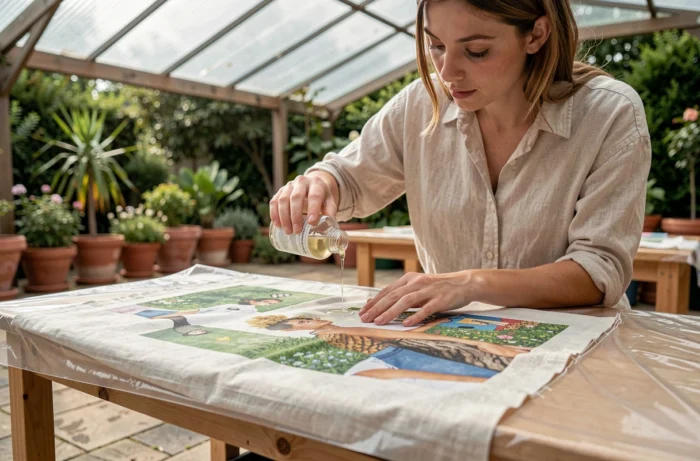
Evaluating the durability of a print is not limited to a home wash followed by a glance. A reliable protocol includes several checkpoints:
- Wash the printed sample at the maximum temperature indicated for the finished garment, with a standard detergent without bleaching agents
- Place a white control fabric in contact with the printed area to measure color transfer (bleeding)
- Repeat the cycle at least three times before evaluation, as some degradations only appear after several washes
- Visually compare the color change with a standardized gray scale, or use a spectrophotometer for objective measurement
This type of verification allows for identifying a fixation problem before it affects an entire batch. For workshops that produce regularly, integrating this control with each change of ink, substrate, or machine setting becomes a cost-effective reflex.
Retouching insufficient fixation
If the test reveals bleeding, a second pass through the heat press can sometimes correct incomplete polymerization. This solution works especially well with plastisol inks. For water-based inks that are already dry on the surface, a new thermal flash may not penetrate deeply enough to complete the cross-linking of the binder.
It is better to adjust the parameters upstream than to rely on a fix. The durable fixation of ink on fabric is determined before the first wash, not after.