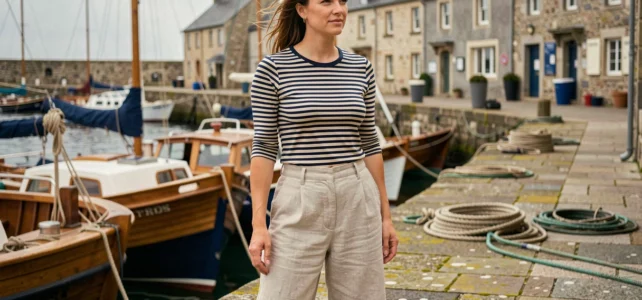
Brittany fashion is not limited to the striped sailor shirt. It refers to a set of creative practices that draw from the textile heritage, local materials, and artisanal know-how of a region where embroidery, wool, and linen have held a central place for centuries. Several designers based in Brittany are renewing this clothing vocabulary by integrating contemporary concerns, from material sustainability to the legal protection of designations.
Textile geographical indications: what the European regulation changes for Brittany
Since December 1, 2025, the Regulation (EU) 2023/2411 allows artisanal and industrial products to benefit from a protected geographical indication at the European level. Previously reserved for agri-food products (cheeses, wines), this system is now open to textiles, embroideries, and clothing.
For a Breton textile product to qualify for this protection, three cumulative conditions must be met:
- The product must originate from a specific geographical area, here the Breton territory.
- Its reputation or characteristics must be essentially linked to this geographical origin.
- At least one production step must be carried out in this area.
In practical terms, this could allow for the legal protection of names related to Brittany, such as a type of embroidery or a specific jacket cut. A brand not locally established would no longer be able to use these designations. The procedure involves a national examination followed by the EUIPO, with protection valid for ten years and renewable.
For Breton creators, this legal tool represents a concrete lever against “Brittany-inspired” collections produced with no connection to the territory. Several players in the regional textile sector are closely monitoring the possibilities opened by this framework, which can be documented on the fashion section of Construire la Bretagne alongside other local initiatives.
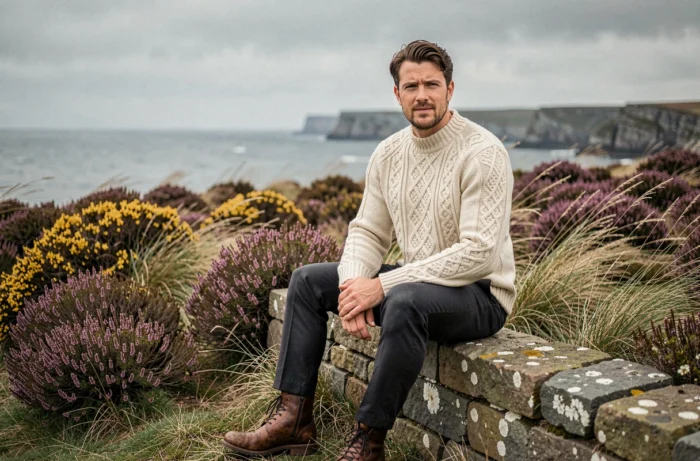
Breton creators: three approaches redefining regional fashion
Designer Nolwenn Faligot, based in Faou, launched her own brand after working at Armor Lux. Her spring-summer 2026 collection, presented during a pop-up shop in Perros-Guirec, illustrates a precise approach: sustainable clothing, accessible to all body types, designed in collaboration with local artists. Her latest series incorporates the creations of Aude Robin, a painter based in Plouër-sur-Rance, whose wave patterns are printed on linen fabric.
This collaborative logic between artisans and artists distinguishes the Breton scene. Pascal Jaouen, a renowned embroiderer, presented an exhibition of eighteen fully recycled outfits at the Interceltic Festival of Lorient. The embroidery work remains identical to that of traditional costumes, but the materials come from recovered textiles.
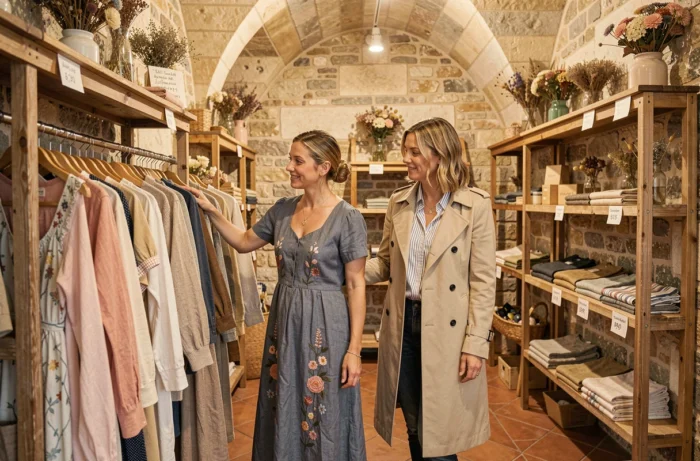
In Douarnenez, four artisans opened a summer pop-up shop to sell pieces combining sewing, embroidery, and local materials. This direct sales format, without intermediaries, is multiplying along the Breton coast and allows creators to control their prices while maintaining direct contact with customers.
Linen and wool as structuring materials
The common thread among these approaches lies in the raw material. Linen, grown in the northwest of France, and local wool are the preferred textile bases. Nolwenn Faligot uses linen for its thermoregulating properties and durability. Pascal Jaouen works with natural fibers compatible with traditional embroidery.
The choice of material precedes the design of the garment, reversing the logic of fast fashion where the model is designed before seeking the cheapest fabric.
Brittany and sustainable fashion: beyond territorial marketing
The brand À l’Aise Breizh has its own screen printing and embroidery workshop, allowing it to control the production chain from motif to finished product. This integrated workshop model, where manufacturing remains in the territory, represents a different positioning from brands that merely place a Breton visual on an imported garment.
The distinction between these two approaches becomes a commercial issue. A consumer buying a “Breton” garment increasingly expects the production to be genuinely local. The new European framework for geographical indications could, in the long term, formalize this expectation by prohibiting the use of a Breton designation for products made elsewhere.
Breton embroidery and contemporary sewing: a technical grammar
The embroidery of Pont-l’Abbé or the Bigouden patterns are not mere ornaments. They follow composition rules passed down in workshops for several generations. Pascal Jaouen teaches these techniques in his embroidery school, which trains new artisans each year.
Applying these patterns to contemporary cuts requires technical adaptation: thread density, tension on modern fabrics, compatibility with current sewing machines. This adaptation work is rarely visible to the end customer, but it conditions the quality of the product.
Breton fashion and distribution channels: workshops, pop-up shops, and sports clubs
Sales channels are evolving. Stade Rennais has launched a lifestyle collection branded Brittany, aimed at an audience that does not necessarily wear the football jersey but identifies with the territory. This type of partnership between sports clubs and regional identity opens an unexpected distribution circuit for Breton textiles.
In Brest, new women’s ready-to-wear boutiques are opening, focusing on local creators. The pop-up shop format, tested in Douarnenez and Perros-Guirec, allows for market testing without heavy real estate commitments. These initiatives outline a distribution network rooted in the territory, complementing online sales.
Current Breton fashion is built on three concrete pillars: traceable materials, documented artisanal know-how, and a European legal framework that is beginning to protect designations linked to the territory. The next test will be to see if Breton creators actually submit a request for geographical indication for their textile products, transforming a cultural heritage into a competitive advantage recognized by law.