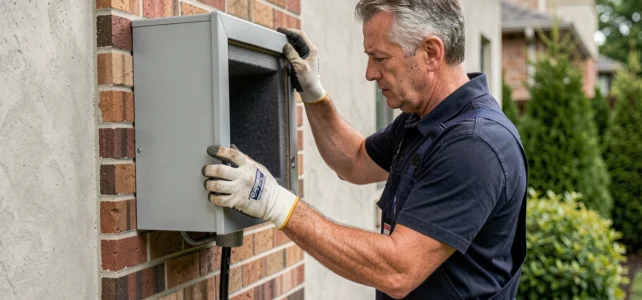
The outdoor unit of an air conditioning system or heat pump generates noise that French law does not subject to any quantified threshold when it comes to individuals. Article R.1336-5 of the Public Health Code assesses nuisance based on its duration, repetition, intensity, and context (night, quiet residential area).
The noise-reducing box for air conditioners does not aim to fall below a specific regulatory value, but to eliminate the “abnormal neighborhood disturbance” as judged by the court.
Sound emergence and legal framework applied to individuals
The famous thresholds of 5 dB(A) during the day and 3 dB(A) at night circulate on most product pages. We observe that these values concern exclusively noise from professional, sports, or leisure activities, not the outdoor unit of an individual. Confusing the two regimes leads to a false sense of compliance.
In practice, an owner remains responsible for the noise from their installation even if the equipment meets the manufacturer’s specifications. A case published in August 2026 by Le Particulier illustrates that a court can impose soundproofing work (relocating the unit, installing an acoustic box, adding a screen) and the payment of damages.
The choice to install the noise-reducing box for air conditioning fits into this logic: sufficiently reducing the emission so that the nuisance can no longer be classified as an abnormal disturbance, rather than aiming for an arbitrary figure.
Ventilated acoustic box: real attenuation and thermal limits
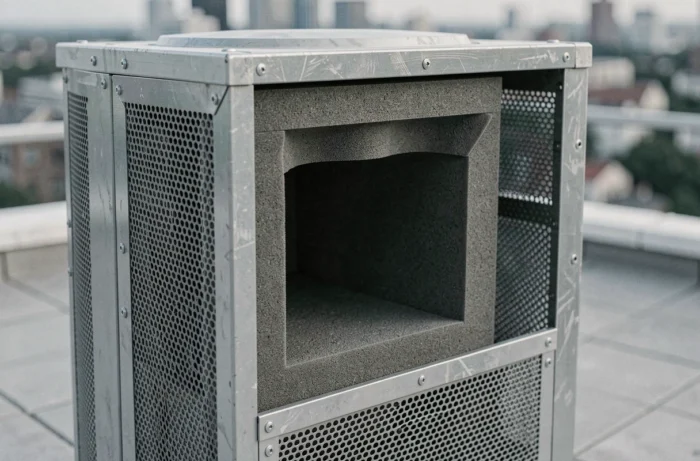
A noise-reducing box closed on five sides with an absorbing material (melamine foam, high-density rock wool) can significantly reduce the perceived noise level at a few meters. The non-negotiable condition is ventilation: the outdoor unit circulates a considerable volume of air to ensure thermal exchange.
A poorly ventilated box degrades the COP and triggers high-pressure safety. The direct consequence is excessive electricity consumption, or even a shutdown of the device during a heatwave. Serious industrial boxes incorporate acoustic baffles (maze-like pathways) that allow air to pass while breaking sound propagation.
Sizing criteria to check before ordering
- The internal volume must exceed that of the outdoor unit by at least the depth necessary to create an air buffer space on each side; otherwise, the recirculation of hot air suffocates the exchanger.
- The total section of the air intake and outlet openings must remain consistent with the nominal flow rate of the unit’s fan, information that the heat pump or air conditioner manufacturer indicates on the technical sheet.
- The absorbing material exposed to the elements must resist moisture without compressing: hydrophobic melamine foam or mineral wool under a technical veil is suitable, while expanded polystyrene is not (it has no acoustic absorption properties).
We recommend asking the box supplier for the acoustic test report (measurement in free field, not in a reverberant chamber) and the induced aerodynamic pressure loss. Without this data, the promise of attenuation remains unverifiable.
Comparison with other noise reduction solutions
The encompassing box is not the only approach. Depending on the site configuration, other devices may suffice or complement the installation.
Anti-vibration mounts and silent blocks
Anti-vibration mounts decouple the unit from the support (concrete slab, wall, metal structure). They address solid transmission, not airborne noise. On a balcony or terrace, they reduce vibrations perceived in the apartment below, but do not help against noise emitted towards the neighboring side.
Partial acoustic screen
An absorbing panel placed between the unit and the receiving point (neighbor’s window, adjoining terrace) creates a sound shadow zone. The attenuation depends on the ratio between the height of the screen and the source-receiver distance. This solution is suitable when the nuisance concerns only one direction but remains ineffective in omnidirectional diffusion.
Ventilated encompassing box
Only the encompassing box addresses noise emitted in all directions. It combines absorption (internal walls) and insulation (mass of external walls). The additional cost is justified when the unit is surrounded by sensitive receivers (courtyard, dense condominium).
Choosing the noise-reducing box: common pitfalls in condominiums
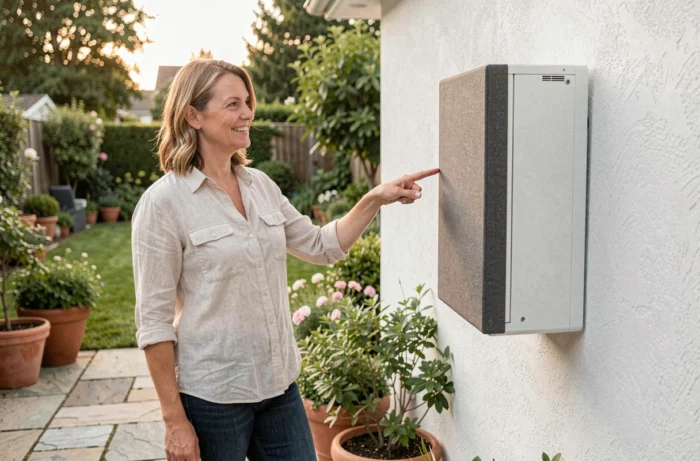
In a condominium, installing a box does not exempt one from obtaining permission from the general assembly if the outdoor unit is fixed to a common area (facade, roof terrace). The condominium regulations may also impose a specific model, color, or service provider.
A common pitfall concerns weight: an acoustic box made of galvanized steel with rock wool filling weighs significantly more than a simple decorative cover made of aluminum. The load-bearing capacity of the support (wall bracket, balcony floor) must be verified, especially in older constructions.
- Check the compatibility of the box with the maintenance distances required by the air conditioner manufacturer (access to filter, service valve, refrigerant connection).
- Prefer a removable box or one with removable panels to allow technician intervention without complete removal.
- Ensure that the box does not create a localized greenhouse effect in summer, which happens when the ventilation openings are undersized or obstructed by surrounding vegetation.
The choice of a noise-reducing box for air conditioning is based on a trade-off between acoustic performance, maintenance of air flow, and installation constraints. A model validated by an independent acoustic test, sized for the unit’s flow rate, and accessible for maintenance protects the comfort of the neighborhood and the longevity of the equipment.