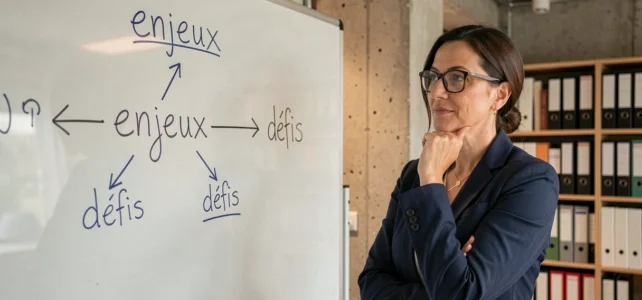
We are drafting a strategic plan for a small to medium-sized enterprise, and in the same meeting, someone talks about climate issues and then about logistical challenges. Everyone nods in agreement, but no one has the same understanding behind these two words. Ambiguity sets in, priorities become blurred, and the action plan goes in three different directions.
Understanding the difference between issues and challenges is primarily a matter of operational clarity: knowing what we risk losing, then identifying what we need to solve in order not to lose it.
Issue and challenge in the workplace: what each word triggers
Let’s take a company that is digitizing its internal services. The issue is medium-term competitiveness: if the transformation fails, the organization loses efficiency against its competitors and degrades the quality of service. We are talking here about what is at stake, what we can gain or lose.
The challenge, in this same project, consists of the concrete obstacles to overcome. For example, resistance to change from teams, lack of digital skills, or disparities in equipment between sites. These are identifiable problems that we can act on directly.
This distinction is found in the analysis of the digitization of the Moroccan public administration: the institutional issues (more transparent administration, better coordination between services) fall under the global strategy, while the organizational, technological, and human challenges are the operational barriers to be removed to achieve these objectives. When we master the difference between issues and challenges, we avoid treating a governance problem as a simple technical bug.
Climate and economic issues: a field where confusion is costly

Climate change provides a case study for distinguishing the two concepts. The climate issue is the preservation of living conditions on the planet: access to water, food security, stability of ecosystems. It is the overall result we seek to protect or risk compromising.
The challenges, on the other hand, are the concrete problems that businesses, communities, and states must solve to address this issue:
- Reducing greenhouse gas emissions in sectors where technical alternatives remain costly or immature
- Adapting existing infrastructures to the impacts of warming (rising waters, droughts, extreme events)
- Financing the transition without exacerbating economic inequalities between regions
The issue sets the direction, the challenge identifies the obstacle on the road. Confusing the two leads to vague action plans. We declare, “our issue is to reduce our emissions,” when in reality, reducing emissions is a challenge. The issue is the sustainability of economic activity in a warming context.
In France, this confusion is found in many corporate strategy documents. The words “issues” and “challenges” are piled up as synonyms, which dilutes the hierarchy of priorities.
Distinction grid between issues and challenges: concrete criteria
To avoid hesitation, we can apply a simple test to each element identified in a project or analysis:
| Criterion | Issue | Challenge |
|---|---|---|
| Nature | What we can gain or lose | The obstacle to overcome |
| Timeframe | Medium or long term | Short or medium term |
| Direct action possible | No (we act on challenges to protect the issue) | Yes (action plan, resources, skills) |
| Example in sustainable development | Preservation of biodiversity | Reduction of pesticide use in an agricultural sector |
| Example in business | Brand reputation | Management of a communication crisis on social media |
An issue is not “resolved”; it is protected or pursued. A challenge, on the other hand, calls for an operational response with means, a timeline, and identified responsibilities.
Application in a report or strategic plan
When drafting a framing document, separating issues and challenges into two distinct sections clarifies the reading. The “issues” section sets the framework: what is at stake for our organization, our territory, our sector. The “challenges” section lists the problems to be addressed, each with a priority level and action pathways.
The annual report of the Court of Auditors of Burundi, published in August 2026, illustrates this method well: the sustainability of public finances is presented as a central issue, while problems of budget governance and execution are treated as persistent challenges to be resolved. This separation makes the diagnosis readable and the recommendations actionable.
Common mistakes and reflexes to adopt daily

The first mistake is using “issue” as a synonym for “important subject.” Saying “the issue of the meeting is to validate the budget” is a misuse of language. The budget is a challenge or an objective. The issue would rather be the financial viability of the project that this budget must secure.
The second mistake is listing challenges without having established the issues beforehand. We end up with a series of actions disconnected from a vision. Teams address problems without knowing why one challenge takes precedence over another.
Here are some reflexes to avoid these pitfalls:
- Before listing challenges, formulate in one sentence what is at stake: “If we do nothing, what do we lose?”
- Check that each identified challenge is linked to an explicit issue; otherwise, a link is missing in the reasoning
- In a written document, never use “issue” and “challenge” interchangeably: choose one word and stick to it for each element
Feedback varies on this point, but in practice, teams that adopt this vocabulary discipline produce significantly more readable framing documents. The distinction between issues and challenges is not a linguistic subtlety: it is a structuring tool that changes the quality of decisions made downstream.