The European regulation on the ecodesign of sustainable products (ESPR) prohibits large companies from destroying their unsold textiles since July 19, 2026. This regulatory constraint reshapes collection logics well beyond the runways. Understanding fashion today means integrating that creation now operates under a legal framework that impacts the number of references, the choice of materials, and the programmed lifespan of each piece.
ESPR Regulation and Ecodesign Constraints on Textile Collections
The ban on the destruction of unsold clothing and shoes in the European Union requires brands to shift towards resale, donation, repackaging, or recycling of surplus stock. An obligation for annual publication of information on the fate of unsold items accompanies this measure.
In practice, we observe a direct effect on the design of collections. Short-lived capsule collections lose their profitability when residual stock can no longer be incinerated. Brands are reducing the number of references per season and favor pieces designed to withstand multiple cycles of use or resale.
The digital product passport, planned as a continuation of the ESPR, will ultimately require each garment to carry an identifier tracing its composition, manufacturing origin, and end-of-life options. Style offices are already integrating this data: a mixed fabric that is difficult to recycle becomes a compliance risk, not just an aesthetic choice.
Several analyses shared on the fashion section of Journal Global show that this regulatory pressure accelerates the use of single-materials and fibers with established recycling pathways.
Fashion Deconsumption in France: What the 2026 Data Says

The Worldpanel by Numerator data confirms a significant trend: fashion is among the most scrutinized spending categories by French households in 2026. The volume of purchases is declining, and the frequency of purchases is decreasing faster than the average basket size.
This deconsumption does not affect all segments equally. Mid-range ready-to-wear is experiencing the sharpest contraction. Luxury resists due to its aspirational positioning, and second-hand captures part of the demand that is moving away from new items.
For creators and professional buyers, the consequence is clear: the relevance of a piece matters more than the rapid renewal of the offer. A streamlined wardrobe, designed around durable basics and a few high-impact stylistic pieces, aligns better with observed purchasing behavior than a parade of micro-trends.
Silhouettes and Materials Shaping Fall-Winter 2026 Fashion
On the spring-summer and then fall-winter 2026 runways, three construction axes clearly emerge.
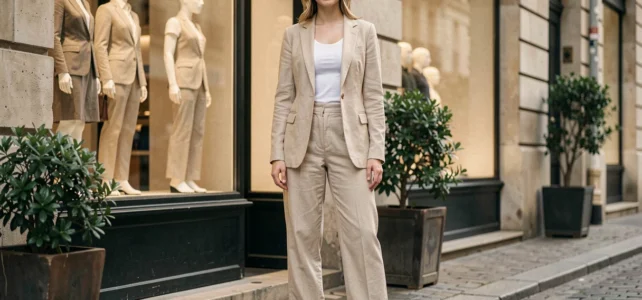
- Controlled volume on the lower body: structured wide pants, sculptural volume skirts. The waist remains defined to anchor the silhouette, while the drape does the rest. Loewe, Saint Laurent, and Miu Miu each presented their interpretation of this proportion.
- The long fluid dress, inspired by the poetcore movement, which favors materials with natural drape (crepe, washed satin, heavy linen). It works in a saturated single color (orange, olive green, sky blue) and is worn with minimalist accessories.
- The coordinated set (matching jacket and pants or skirt), which simplifies the composition of the look while producing immediate visual impact. This format also reduces cognitive load at purchase, an asset in a more thoughtful consumption context.
In terms of materials, natural mono-fibers are gaining ground over synthetic blends, driven both by the ESPR regulation and perceived demand for sustainability. Linen, untreated merino wool, and thick organic cotton are making a strong comeback in the trend books of Texworld fairs.
Fall-Winter 2026 Colors: Tight Palette and Controlled Intensity
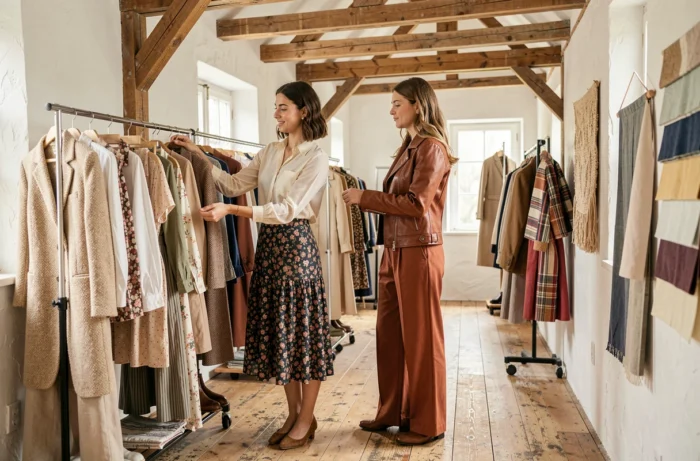
The palettes presented for the cold season 2026-2027 abandon chromatic excess. We observe a return to deep shades (burgundy, tobacco brown, midnight blue) paired with warm neutrals (buttery beige, ecru, stone gray).
Butter yellow remains a strong marker of the summer-to-fall transition, worn as a standout piece against a neutral base. Bright colors do not disappear, but they concentrate on a single element of the look rather than saturating the entire outfit.
This logic of a tighter palette aligns with the trend towards deconsumption. A garment in a versatile color is easier to combine with an existing wardrobe, extending its rotation time in the closet. Style offices now recommend that brands limit the number of colors per model to reduce the risk of unsold items, thus closing the loop with the regulatory constraints mentioned earlier.
Reddit, TikTok, and Pinterest Predicts: Where Fashion Trends Really Emerge
The Pinterest Predicts report remains a reference for anticipating which pieces will emerge, relying on actual user search volumes. Reddit data, less exploited by traditional fashion media, offers valuable insights: discussions in specialized subreddits (r/femalefashionadvice, r/malefashionadvice) highlight micro-trends from the ground before they reach high-audience Instagram accounts.
Trends that last often emerge in discussion communities, not on the runways. Poetcore, for example, circulated on TikTok and Reddit for several months before appearing in the spring-summer 2026 collections of major houses.
For industry professionals, cross-referencing Pinterest search data with Reddit conversations allows for the identification of weak signals before media saturation. This provides a direct competitive advantage in the buying and production timeline.
Fashion in 2026 is viewed through a triple filter: regulatory (ESPR, digital passport), behavioral (deconsumption, streamlined wardrobe), and aesthetic (controlled volumes, mono-materials, deep palettes). The collections that will perform are those that simultaneously meet these three requirements without sacrificing the uniqueness of style to conform to the framework.