
During a roadside check, verifying a driver’s license is no longer just a quick glance at a laminated document. Law enforcement now has several methods, from classic visual checks to real-time access to national databases, to ensure that a driver is indeed authorized to be behind the wheel. What tools and databases are actually used, and how will the new European regulations change these practices?
National Databases Consulted During a License Check
The most visible action, the request for the physical document, is just the first step. Behind this, officers access centralized databases that provide a complete picture of the driver’s situation.
The National Driver’s License File (FNPC) is the main tool. It lists all licenses issued in France, their category, their validity date, and most importantly, the remaining points balance. Police and gendarmes access it from their onboard terminals or through their command center.
This file allows for immediate detection of a canceled, suspended, or invalidated license due to a zero points balance. Understanding how the police verify the license involves this systematic consultation, which makes it very difficult to drive with a revoked title.
The Vehicle Registration System (SIV) complements the setup. By cross-referencing the license plate with the FNPC, officers can verify whether the driver possesses the appropriate license category for the vehicle they are driving. A motorist driving a heavy truck with a B license, for example, is clearly identified.
| Control Method | Accessible Data | Response Time |
|---|---|---|
| Visual examination of the document | Photo, category, expiration date | Immediate |
| FNPC consultation (onboard terminal) | Validity, points balance, suspensions, cancellations | Several seconds |
| SIV + FNPC cross-check | Matching license category / vehicle driven | Several seconds |
| QR code scan (recent licenses) | Document authenticity, encoded data | Immediate |
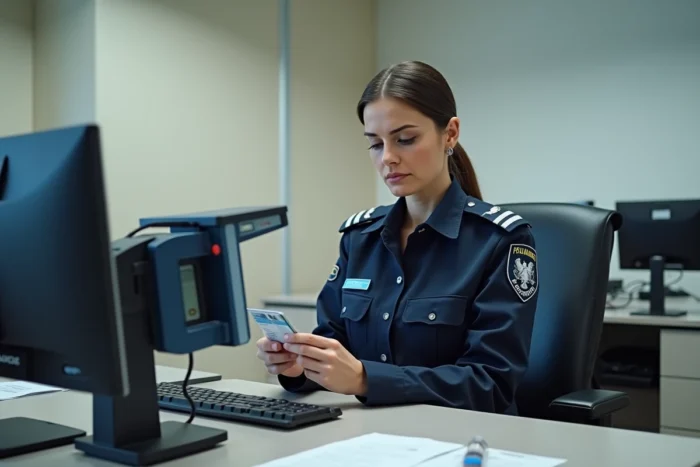
Visual Inspection and Detection of Fake Driver’s Licenses
Consulting databases does not exempt officers from a physical examination of the document. Officers are trained to spot security features integrated into credit card-sized licenses: holograms, micro-printing, UV-reactive ink.
The old-generation “pink paper” licenses, still in circulation for a few more years, pose a specific problem. Their security level is significantly lower than that of recent cards, making them more vulnerable to forgery. Law enforcement compensates for this weakness with a systematic check in the FNPC, the only reliable way to confirm the validity of an old license.
Recent licenses incorporate a QR code that officers can scan directly. This code links to the data encoded in the document and allows for the detection of any alterations. A physically convincing fake license will be betrayed by an invalid or missing QR code.
Digital Driver’s License and Dematerialized Control
France is preparing, as part of a European reform, to implement a dematerialized driver’s license integrated into the European digital identity wallet. This license would be accessible via an official application recognized throughout the European Union.
For law enforcement, this change is significant. The digital license will be consultable and verifiable in real-time from any checkpoint, without relying on the physical document that the driver may have forgotten at home. Validity, category, and suspension checks would become instantaneous and would no longer depend on a manual cross-check between the presented document and the database.
The physical license would still be available as an option. The new European regulations also foresee the end of lifetime licenses, with periodic renewals that will keep biometric and administrative data up to date.
What Digitalization Means for the Driver
- Presenting one’s license from a phone during a roadside check will be legally valid in all EU countries once the system is deployed
- The QR code of the digital license will be verifiable offline, covering white zones
- A suspended or canceled license will be automatically invalidated in the application, making fraudulent presentation impossible
Refusal of Roadside Checks: An Increase That Changes Practices
Methods for checking licenses are also evolving in response to behaviors on the ground. Data published by the Ministry of the Interior via Interstats indicate a marked increase in refusals of roadside checks in 2025, with some overseas territories (Guadeloupe, Martinique) leading the statistics.
This trend has direct consequences on procedures. Law enforcement is adapting their measures:
- Increasing coordinated checks between the national police, gendarmerie, and customs, such as operations by the border intervention force
- Growing use of automated license plate reading (LAPI), which allows for the identification of a flagged vehicle even before an arrest
- Strengthening targeted checks at times and locations where serious offenses (alcohol, drugs, lack of license) are statistically more frequent
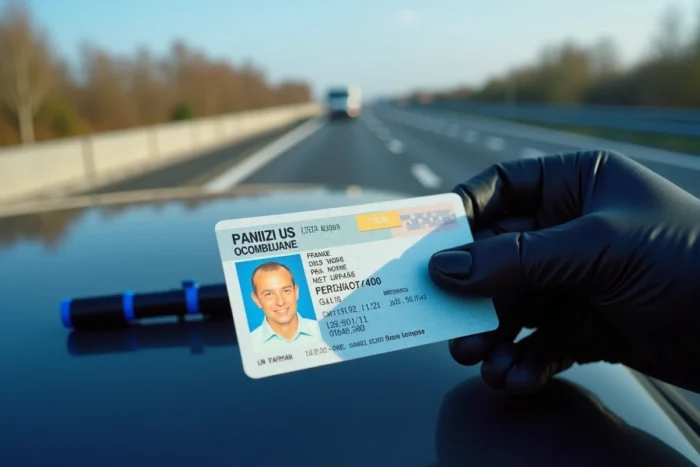
Refusing to comply constitutes an offense punishable by severe criminal penalties, distinct from the initial traffic violation. However, remote consultation of files allows officers to gather some information (via the license plate) even when the driver flees, facilitating subsequent legal proceedings.
Thus, checking the driver’s license relies on a stack of complementary methods: physical document, national databases, and soon digital identity. The shift towards a dematerialized license, expected in a few years, should significantly reduce opportunities for fraud while making each verification faster for both officers and drivers.