
Are you preparing a trip to Belgium and don’t know where to start to compile your visa application? The process may seem complex, but it is based on a simple logic: prove your identity, justify the purpose of your trip, and demonstrate that you can finance your stay. Here’s what you really need to prepare, step by step.
Passport and photo: the pitfalls that block a Belgium visa application
Before even thinking about financial documents, an application often hinges on two pieces that everyone considers taken for granted: the passport and the identity photo.
The passport must be valid for at least three months after the expiration date of the requested visa. Specifically, if you are applying for a short-stay visa valid until March, your passport must remain valid until at least June. Also, make sure it contains at least two consecutive blank pages.
The photo must comply with ICAO standards: light background, clear face, recent format. A photo taken more than six months ago or with reflections on glasses can lead to the rejection of the application. These details may seem trivial, but consular agents check them systematically.
Gathering the documents for a Belgium visa application requires treating each piece with the same rigor, including those that seem obvious.
Financial documents and travel insurance for a Schengen visa to Belgium

This is the part of the application that generates the most refusals. The Belgian consulate wants to ensure that you will not be a burden on the state during your stay. There are two main options to prove this.
Personal means of the applicant
You are financing your trip yourself. In this case, the application must include:
- Bank statements covering the last three months, with visible transactions (not just a simple balance)
- Recent pay slips or any document proving regular income in your country of residence
- Proof of funds dedicated to the trip: international bank card with associated statement, certified check, or any equivalent proof
The consulate does not publicly set a unique minimum amount. What matters is the regularity and consistency of the income, not an isolated figure on a statement.
Coverage by a sponsor in Belgium
If a Belgian resident invites you and covers your expenses, they must provide a sponsorship commitment (annex 3bis) legalized by their municipality. This document must be accompanied by a copy of their ID card or residence permit, and proof of solvency: pay slips from the last three months or a recent tax notice.
Travel insurance is mandatory for any Schengen visa. It must cover medical expenses and repatriation, with a minimum coverage valid for the entire Schengen area. Without this insurance, the application is automatically incomplete.
Proof of accommodation and purpose of stay in Belgium
The consulate needs to understand why you are coming and where you will be staying. These two elements are linked: the type of accommodation expected depends on the declared purpose.
For a tourist trip, a hotel reservation with proof of payment of a deposit is usually sufficient. If you are staying with a private individual, a legalized accommodation certificate is required. For a business trip, an invitation letter from the Belgian company specifying the purpose and duration of the trip is expected.
Each purpose of stay requires specific documents. A family visit requires proof of the family relationship. A short study stay requires a certificate from the educational institution. Do not mix categories: an application that states a tourist trip but presents a company letter creates an inconsistency that the consulate will notice.
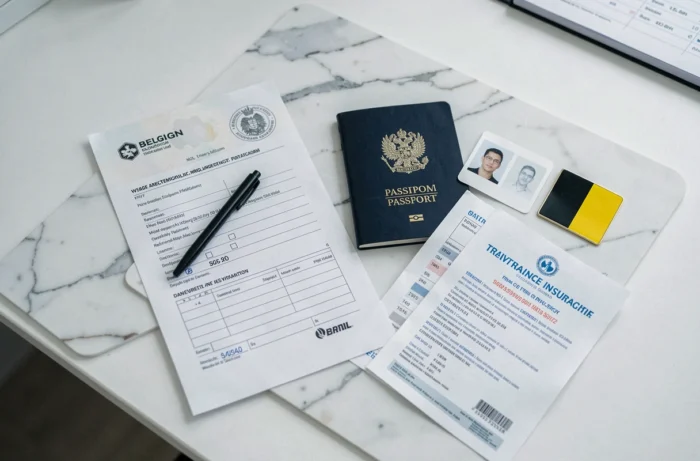
A round-trip transport reservation completes this section. It confirms that you plan to leave the Schengen area before the expiration of the requested visa.
Submitting the application at the Belgian embassy: deadlines and consular fees
The complete application is submitted to the competent Belgian embassy or consulate in your country of residence. For residents in France, it is the Consulate General of Belgium in Paris, accessible by appointment only.
Generally, two types of fees apply: an administrative fee and consular fees. The amounts vary depending on the visa category and the nationality of the applicant. You should submit the application well in advance, and a maximum of six months before the planned travel date. Processing times fluctuate depending on the time of year and the complexity of the application.
Here are the documents to gather in order to avoid back-and-forth:
- Valid passport (with copies of the identity pages and pages with a visa)
- Completed and signed visa application form, accompanied by a recent photo
- Travel insurance covering the Schengen area
- Financial documents (personal or sponsorship)
- Proof of accommodation and round-trip transport
- Documents related to the purpose of stay (invitation, reservation, certificate)
An incomplete application is the primary cause of delays or refusals. It is better to postpone an appointment by a few days than to submit an application missing a document.
ETIAS and EES system: what changes for entering Belgium
If you are among the visa-exempt nationals for a short stay in Belgium, a regulatory change directly affects you. The ETIAS system will become mandatory starting in the last quarter of 2026 for travelers who currently do not need a Schengen visa. This electronic travel authorization must be obtained before boarding to the Schengen area.
At the same time, the EES (Entry/Exit System) will replace manual passport stamps with automated biometric registration at Schengen borders. Entry and exit data will be stored digitally, allowing for automatic verification of compliance with the authorized length of stay.
These two systems do not change the list of documents for a standard visa application. They concern travelers who, until now, entered Belgium without prior formalities. The distinction between the two regimes (visa required and visa exemption) remains the same, but controls are tightening for everyone.
Preparing a visa application for Belgium is primarily a matter of method. Each document has a specific function, and it is the overall consistency of the application—purpose, accommodation, finances, duration—that determines the outcome of the request.