
You receive a link in an email or in the messaging of Le Bon Coin, you hover to click, and the displayed text is replaced by the mention “URL hidden for your security.” The first reflex is to look for how to remove this message to access the link. In most cases, this reflex leads to the wrong solution.
Removing the hidden URL warning: why it’s rarely the right goal
The message is not a bug. It’s a filter triggered upstream, on the server or platform side, even before the link appears in your browser. On Le Bon Coin, any external URL posted in the internal messaging is hidden by design, whether it is dangerous or perfectly safe. On Gmail and Outlook, the mechanism relies on a reputation score of the target domain, the number of redirects, and the presence of URL shorteners.
Trying to remove the hidden URL message for your security often amounts to disabling a layer of protection without addressing the real problem: we still don’t know if the link is trustworthy.
The absence of a warning does not guarantee the safety of a link. A recently registered fraudulent site may not appear on any blocklist. The browser then displays nothing suspicious, and the trap works. The “hidden URL” message indicates a doubt from the filter, not a certainty of danger, but its disappearance proves nothing either.
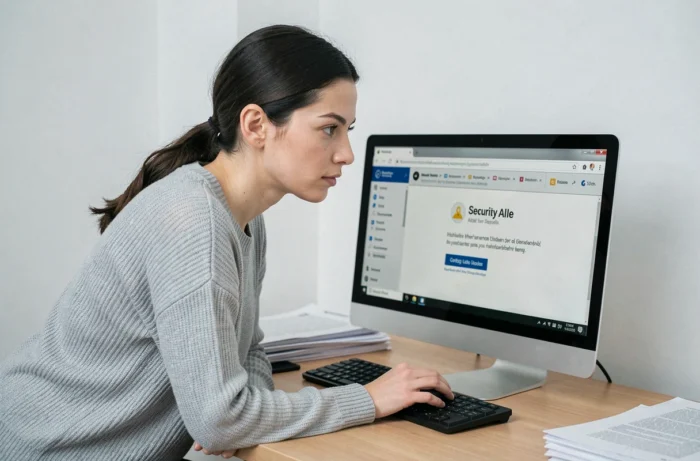
Check a hidden link before opening it: the concrete method
Rather than forcing the issue, you can check the actual destination of the link without taking risks. Here are the steps that work regardless of the browser (Chrome, Firefox, Edge) or platform.
- Hover over the link without clicking: on a computer, the actual destination appears at the bottom left of the browser window. If the displayed address does not match the expected domain, stop there.
- Copy the link and paste it into a verification tool: services like CheckShortURL or VirusTotal allow you to unfold redirects and analyze the reputation of the final domain without ever opening the page.
- Open the link in a private browsing tab: this limits the exposure of cookies and session data if the page turns out to be suspicious, but it does not replace prior verification.
- Compare the domain with the sender: a link that is supposed to lead to a known payment service but whose domain contains unusual characters or a third-party subdomain is a strong warning signal.
On mobile, hovering does not exist. You press and hold on the link to display the full URL before opening it. On Le Bon Coin, asking the interlocutor to provide the address in plain text (without a clickable link) remains the simplest way to bypass the automatic masking.
Browser anti-phishing filtering: Chrome and Firefox settings to know
Browsers integrate their own layer of protection, distinct from that of the platforms. Chrome uses Safe Browsing, while Firefox relies on a similar system of reported domain lists. These filters compare each visited URL with continuously updated databases.
Adjusting the protection level in Chrome
In Chrome’s settings, the “Privacy and security” section offers three levels of safe browsing. The “Enhanced protection” mode sends URLs in real-time to Google servers for analysis. The “Standard protection” mode simply compares against a locally downloaded list. Completely disabling protection is technically possible but not recommended, especially if you don’t have any other active filtering tool.
Adjusting filtering in Firefox
Firefox groups its options under “Privacy and security.” The “Block dangerous or deceptive content” checkbox controls anti-phishing filtering. Unchecking it removes warnings, including on genuinely malicious pages. Feedback varies on this point: some advanced users prefer to manage verification themselves with dedicated extensions, but for everyday use, the native filter remains the most reliable protection.
When the masking comes from the network or application, not the browser
In a corporate environment, the message may come from a network filtering layer. Corporate proxies, solutions like Symantec Endpoint Protection, or Microsoft 365 mail gateways (SafeLinks) rewrite URLs before they reach the inbox. In this case, modifying browser settings does not change anything: filtering operates upstream.
Some mobile applications also add their own layer. Banking apps, secure messaging, and even some telecom operator apps intercept outgoing links and display a generic warning. The only option then is to copy the URL, verify it manually, and then open it in the phone’s browser.
Address bar and HTTPS certificate: what no longer proves anything
A common reflex is to check the padlock in the address bar to ensure that a site is safe. This padlock confirms that the connection is encrypted via an SSL certificate, not that the site is legitimate. A phishing site can very well have a valid HTTPS certificate.
Types of spoofing vulnerabilities can even alter the display of the URL in the address bar on certain browser versions. The displayed domain may seem correct while the actual destination is different. This is why off-browser verification (copy-pasting into an analysis tool) remains more reliable than simply reading the address bar.
- The HTTPS padlock confirms the encryption of the connection, not the identity of the site owner.
- A domain registered a few days ago can obtain an SSL certificate in a matter of minutes.
- Comparing the domain displayed in the email with the actual domain of the link remains the quickest check to perform.
The message “URL hidden for your security” is not an obstacle to bypass. It is a signal that reminds a simple rule: checking a link before opening it protects better than any browser setting. If the link is legitimate, the verification takes a few seconds. If it is not, those few seconds can prevent the worst.