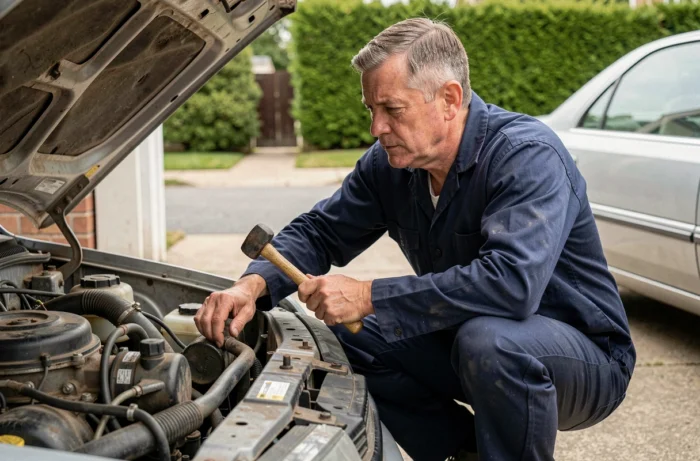
A starter that fails to turn the engine over doesn’t always mean the starter itself is at fault. Before grabbing a tool to hit the housing, you need to pinpoint the problem: a sticking solenoid, worn brushes, or simply a battery unable to deliver the required current. The difference between these situations radically changes what you should do and the consequences.
Differential diagnosis: seized starter or weak battery
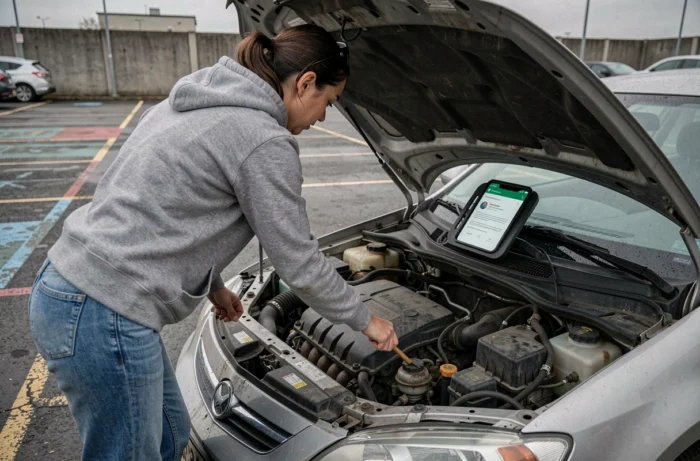
Hitting the starter when the battery is actually to blame is the most common pitfall. When the solenoid receives insufficient voltage, it makes a sharp click without engaging the pinion. The symptom is almost identical to that of a seized starter.
The electrical behavior during an attempted start helps identify the cause. If the dashboard goes dark or the warning lights dim noticeably when you turn the key, the problem lies upstream: a discharged battery or corroded terminal. Hitting the starter in this case won’t change anything and could damage a component that’s working properly.
A solenoid that clicks firmly (a distinct click, with the dashboard lights staying steady) while the armature fails to turn points to a sticking internal contact or stuck brushes. This is the only scenario in which tapping the starter has any real mechanical benefit.
The page explaining where to tap a starter specifies the exact area to target for each engine configuration—a detail most generic guides don’t cover.
Where to hit a starter and what to use
The aim of tapping is to free an armature immobilized by worn brushes or a dirty commutator. The slight vibration helps restore contact between the brushes and the commutator’s copper segments.
Precise striking area
Only the cylindrical body of the starter is a suitable target. This aluminum or steel housing encloses the armature and is located opposite the solenoid. Hitting the solenoid (the small cylinder mounted on top and connected to the battery’s positive cable) could damage the internal contact or bend the pinion shift fork.
On transverse engines (front-wheel-drive vehicles), the starter is located on the transmission side. It’s often accessible from underneath or from the engine bay, behind the intake manifold.
Suitable tools
- A ratchet handle or metal socket extension, used to deliver a light tap, can reach the housing without excessive force.
- A rubber or nylon mallet reduces the risk of chipping aluminum housings, which are common on newer engines.
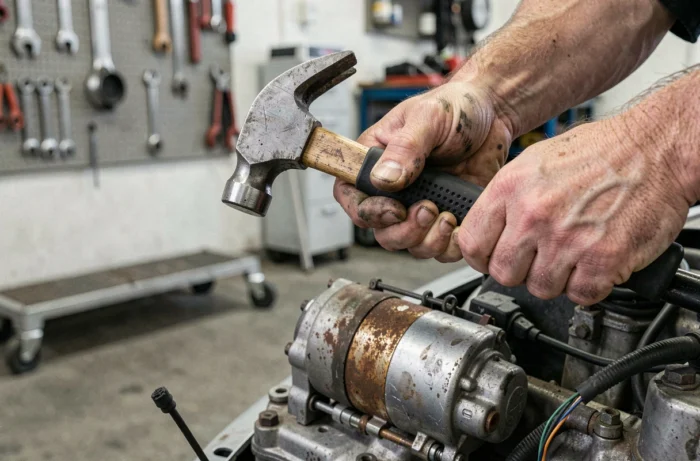
- A steel-headed hammer used for direct blows should be avoided: it can dent the housing, crack a lightweight alloy casing, and transmit an excessively harsh shock to the armature’s internal bearings.
The blows should be firm but moderate, like knocking on a table with your fist. Two or three taps are enough. If the starter doesn’t respond after five attempts while simultaneously turning the ignition key, tapping won’t solve the problem.
When hitting the starter makes the problem worse
Gear-reduction starters contain a compact planetary gear train. A poorly aimed or overly forceful blow can break a tooth in the gear train, turning a simple sticking issue into a complete starter replacement.
Permanent-magnet starters come with an additional risk. Unlike wound-field coils, their ceramic magnets don’t withstand mechanical shocks well. A cracked magnet reduces available torque and causes sluggish starting, even after the original electrical contact issue has been resolved.
Vehicles equipped with a Stop & Start system are another sensitive case. Their reinforced starter includes electronic control components (a crankshaft position sensor and control module). An impact can damage a sensor or trigger a fault code in the engine control unit.
Recurring starter problems: signs of terminal wear
If tapping works once, it confirms that contact between the brushes and commutator has deteriorated. A starter that needs the same treatment several mornings in a row is nearing the end of its life.
Tell-tale symptoms include:
- The starter turns slowly, as if it lacks power, despite the battery testing good.
- A metallic grinding noise when starting indicates that the drive pinion (Bendix) is no longer engaging properly with the flywheel ring gear.
- A burning smell after several prolonged attempts indicates that the armature windings are overheating, a sign of a short circuit between turns.
- The starter works when hot but won’t turn when cold: the shortened brushes lose contact as the commutator copper contracts with the drop in temperature.
A starter that needs to be hit to work cannot be permanently repaired while still in the vehicle. Tapping is a roadside fix, not a solution. Rebuilding it (replacing the brushes, resurfacing the commutator, and checking the bearings) or replacing it entirely are the only lasting options.
One final point that’s often overlooked: the engine-to-body ground cable. A corroded or loose cable creates unwanted resistance that mimics a worn-out starter exactly. Checking it can prevent an unnecessary replacement.