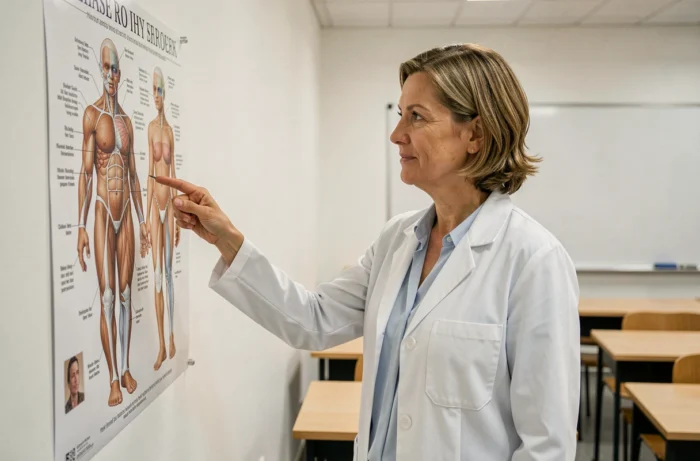
When we think of the body’s organs and structures, the letter V isn’t the first one that comes to mind. Yet it encompasses vital parts: veins, ventricles, the bladder, vertebrae, the vulva and the vagina. Each has a specific function, often misunderstood or confused with that of a nearby anatomical structure. This article takes a closer look at the main parts of the human body that begin with V, explaining what they do and why they deserve our attention.
Veins and valves: how blood flows back to the heart
Veins are the blood vessels that carry blood back to the heart after the organs have used its oxygen. Unlike arteries, they carry oxygen-poor blood (except for the pulmonary veins, which do the opposite).
Have you ever noticed that the veins in your legs have to move blood a considerable distance upward, against gravity? They don’t do this alone. Two mechanisms help them.
The first is the venous valves. Imagine small flaps inside the vein: they open to let blood flow upward, then close to stop it from flowing back down. The second mechanism is the contraction of the muscles surrounding the veins, particularly in the calves. Every step you take compresses the veins and pushes blood toward the heart.
When these valves don’t work properly, blood pools in the veins of the legs. This causes varicose veins, which are enlarged veins visible beneath the skin. A comprehensive guide to parts of the human body that begin with V helps put each structure in its anatomical context.
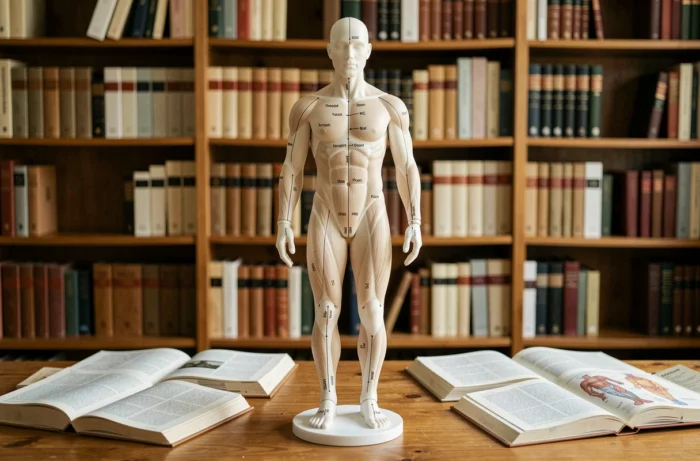
Heart and brain ventricles: two cavities, two functions
The word “ventricle” refers to a cavity. The body has ventricles in two very different organs: the heart and the brain.
Heart ventricles
The heart has two ventricles, a left and a right. The right ventricle sends blood to the lungs to pick up oxygen. The thicker, more powerful left ventricle then pumps this oxygenated blood throughout the body via the aorta.
The left ventricle does most of the work of circulating blood. Its muscular wall is considerably thicker than that of the right ventricle because the pressure needed to supply the entire body is much greater than the pressure needed to reach the lungs.
Brain ventricles
In the brain, the ventricles are cavities filled with cerebrospinal fluid. This fluid protects the brain from impacts, much like a hydraulic cushion. It also helps remove waste produced by neuronal activity.
The brain has four interconnected ventricles. Cerebrospinal fluid circulates through them continuously, is replenished several times a day, and is then reabsorbed into the bloodstream.
Bladder, vagina and vulva: three organs often confused
These three terms all begin with V, refer to the lower part of the torso, and are often mixed up in everyday speech. Their functions, however, are quite distinct.
- The bladder is a muscular reservoir that stores urine produced by the kidneys. It doesn’t filter anything: it collects urine, then contracts to release it through the urethra. Its capacity varies from person to person, but it signals the need to urinate well before it is full.
- The vagina is an internal canal between the vulva and the uterus. It plays a role in sexual intercourse, childbirth and the passage of menstrual blood. It is a flexible muscular structure, not an external organ.
- The vulva refers to all the external female genital organs: the labia majora, labia minora, clitoris, vaginal opening and urethral opening. Using “vagina” to refer to the vulva is a common anatomical mistake.
The distinction is easy to remember: the vulva is what you can see, the vagina is what you can’t, and the bladder belongs to the urinary system, not the reproductive system.

Vertebrae and gallbladder: skeletal and digestive structures
Two other parts of the body that begin with V are worth explaining, as their names are often mentioned without a clear understanding of their roles.
Vertebrae: the backbone of the spine
Vertebrae are the stacked bones that form the spinal column. They protect the spinal cord, the bundle of nerves that connects the brain to the rest of the body. Without this bony protection, even a minor blow to the back could cause paralysis.
Each vertebra is separated from the next by a flexible disc that cushions pressure. The spine has several types of vertebrae: cervical (in the neck), thoracic (in the middle back), lumbar (in the lower back), sacral and coccygeal. They increase in size from top to bottom because they have to support more weight lower down.
The gallbladder: a small reservoir beneath the liver
The gallbladder stores bile produced by the liver. After a meal, it contracts and releases bile into the small intestine. Bile helps digest fats by breaking them down, much like dish soap emulsifies oil in water.
You can live without a gallbladder. After it is removed (cholecystectomy), bile flows directly from the liver into the intestine continuously, rather than being stored and released as needed.
The face and the vomer: facial anatomy
The face is not a single organ but a complex anatomical region. It includes the eyes, nose, mouth, facial expression muscles, sensory and motor nerves, and several bones of the skull.
Among these bones, the vomer is one of the least well known. It is a thin, flat bone that forms the lower part of the nasal septum, which separates the two nostrils. The vomer articulates with several other skull bones, and a deviated septum can make nasal breathing difficult.
In anatomy, the letter V therefore covers a wide range: from the cardiovascular system (veins, ventricles and valves) to the urinary system (bladder), as well as the skeleton (vertebrae and vomer), digestion (gallbladder) and reproductive system (vagina and vulva). Each structure has a specific role that no other structure can take over, which is why medicine has distinct specialties devoted to them.