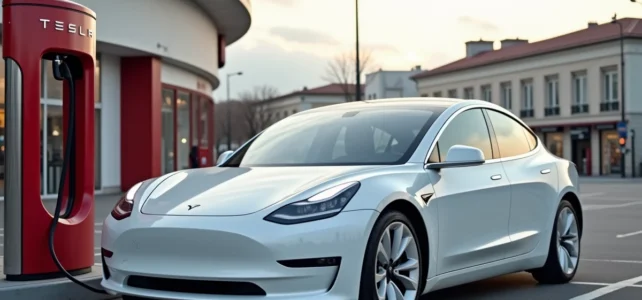
In France, the rapid charging network for electric vehicles has been expanding at a steady pace in recent years. Tesla, a pioneer in the segment, built its own Supercharger network long before most manufacturers took an interest in the issue. With nearly 179 Supercharger sites recorded across France and a gradual opening to non-Tesla vehicles, the American manufacturer’s strategy regarding its charging network deserves careful examination.
Tesla Superchargers in France: a proprietary network turned public
The network that Tesla uses to charge its electric cars primarily relies on its Superchargers, fast DC charging stations deployed and operated by Tesla itself. This vertically integrated model (the automaker is also the charging operator) remains an exception in the French landscape, where most networks are managed by independent operators like Ionity, TotalEnergies, or Fastned.
The turning point occurred when Tesla opened all of its French Superchargers to vehicles equipped with a CCS2 plug, which means almost all electric cars sold in Europe. Activation and payment go through the Tesla app, even for drivers of other brands. The Tesla network in France now operates as a public multi-brand network, while remaining exclusively operated by Tesla.
To delve deeper into the specifics of this network and the available charging options, you can learn more on Ma Future Voiture, which details the various configurations accessible to drivers.
Supercharger pricing: what drivers actually pay
The opening of the network to non-Tesla vehicles comes with a structured pricing differentiation. Tesla owners benefit from a preferential rate, generally around 0.39 euros per kWh at French Superchargers.
Drivers of vehicles from other brands pay a higher rate, around 0.59 euros per kWh without a subscription. However, Tesla offers a monthly subscription plan (Tesla Multipass) that allows non-Tesla drivers to access a rate aligned with that of Tesla owners, at about 0.39 euros per kWh.
This pricing strategy raises a practical question: for a non-Tesla driver who regularly charges at Superchargers, the subscription becomes cost-effective after just a few monthly sessions. In contrast, for occasional use, the additional cost compared to some competing networks can be significant.
Destination Charging stations: the overlooked complement
Beyond Superchargers, Tesla deploys a second, less publicized network: the “Destination Charging” stations. Installed in partner hotels, restaurants, and parking lots, these stations provide a more modest power level, suitable for charging over several hours during a meal or a hotel stay.
These Destination Charging stations are generally not billed directly by Tesla, with the cost covered by the host establishment. Their presence remains uneven across the territory and depends on local partnerships established by Tesla.
Tesla Multipass Roaming: access to third-party networks from the Tesla screen
One aspect that competing articles cover little is the operation of roaming via Tesla Multipass. This service allows Tesla drivers to access third-party charging networks directly from their vehicle’s navigation interface or mobile app, without having to juggle multiple cards and subscriptions.
Specifically, Tesla Multipass aggregates access to several major French and European operators. Thus, Tesla drivers can charge at stations that do not bear the Tesla logo while maintaining centralized billing. The networks accessible through this system evolve regularly as Tesla signs roaming agreements.
- Tesla Superchargers (proprietary network, fast DC stations) form the main charging foundation for Tesla vehicles in France
- Destination Charging stations (secondary network in alternating current) complement the network in accommodation and dining locations
- The Tesla Multipass service provides access to third-party networks (Ionity, TotalEnergies, and other partner operators) via unified billing
Tesla 500 kW stations in France: installed power vs. actual power
Tesla has begun installing its first stations advertised at 500 kW maximum power in France. This impressive figure calls for a technical clarification that press releases often overlook: currently marketed Tesla vehicles limit their charging acceptance to 250 kW.
In other words, the station can deliver 500 kW, but no current Tesla can absorb that much. The investment in these next-generation stations aims at future models from the manufacturer and, potentially, vehicles from other brands capable of accepting such power levels. For the driver of a Model 3 or Model Y, the effective charging speed remains the same at a 500 kW station as at a 250 kW station.
This discrepancy between installed power and usable power raises questions about the communication surrounding these infrastructures. It is not a technical flaw but a bet on the future, as the batteries of the next generations of vehicles are theoretically expected to accept higher power levels.
Reliability of the Tesla network compared to competitors
According to the Chargemap 2025 ranking, based on feedback from over 132,000 users and 460,000 reviews, the Tesla Supercharger network receives an average rating of 4.5 out of 5. This score places it among the highest-rated networks in France in terms of user experience.
The perceived reliability is due to several factors: availability of charging stations, speed of the session, and simplicity of the payment process. Field feedback sometimes diverges on stations with high traffic, particularly near highways during holiday periods, where waiting times can extend despite the number of charging points.
The Tesla network in France thus combines a dense proprietary infrastructure, an opening to other brands that alters its positioning, and a roaming system that extends its reach well beyond just Superchargers. The differentiated pricing and the arrival of ultra-powerful stations still underutilized by current vehicles outline a network in transition, whose economic balance will depend as much on the pace of EV adoption in France as on Tesla’s ability to maintain its lead in reliability.